
How to revise GCSE Geography: the CRAM method for top grades
Why rewriting notes rarely moves GCSE Geography grades, and how the CRAM method (Create, Recall, Again, Mark) helps students revise for top grades.
Freya Ruparel · 2 November 2026 · 3 min read · Blog
Last reviewed 2 November 2026
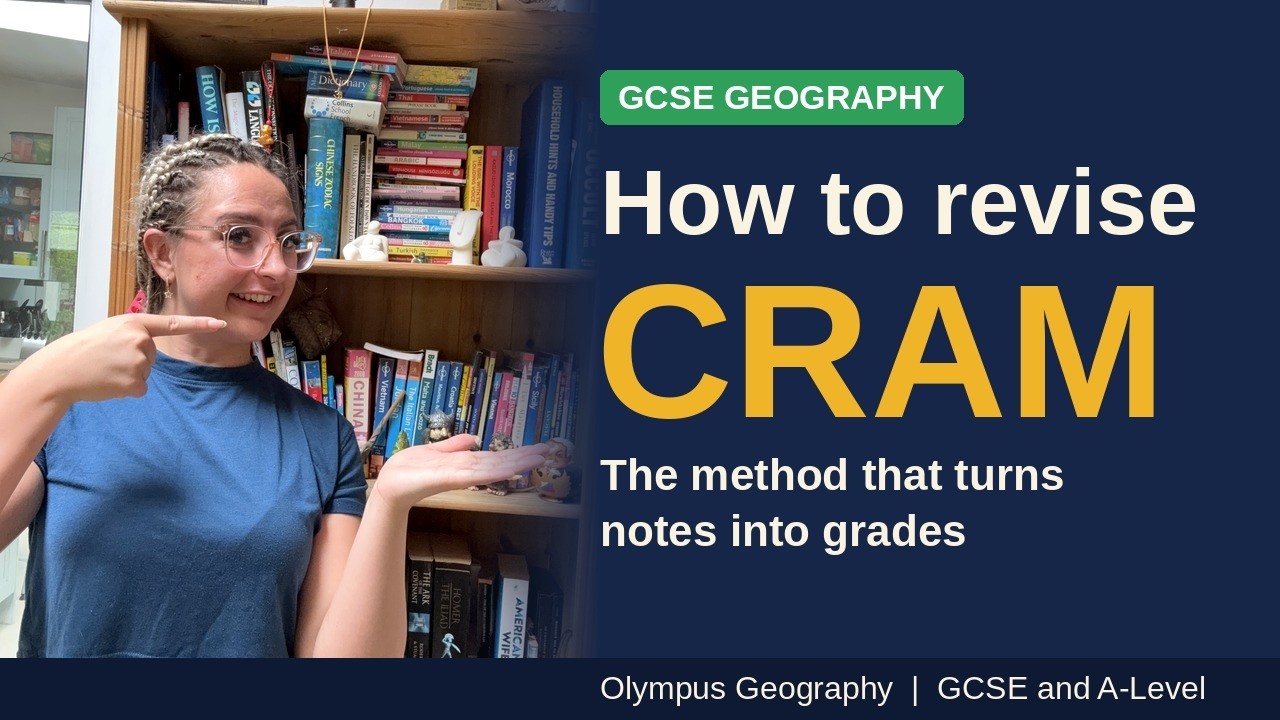
Most GCSE students revise by rereading and rewriting their notes. It feels productive, but it rarely moves the grade. On Thursday 29 October 2026 I ran a free live revision Q&A for students and parents on what to do instead, built around one simple method: CRAM. You can watch the full 35 minute replay below.
What the session covers
Why rewriting notes is so tempting and so ineffective, the four steps of the CRAM method, how to choose what to revise first, why mixing topics works, and the everyday habits that make revision stick. It finishes with three things to try this week.
Why rewriting notes rarely moves grades
Copying notes out neatly keeps your hands busy but asks very little of your memory. The information is in front of you the whole time, so it feels familiar, and familiar feels like learned. In the exam there are no notes to look at. Revision only works when it makes you pull information out of your own head.
The CRAM method
- Create: turn your notes into something new, such as a diagram, a set of flashcards or a mind map. Changing the format forces you to understand it.
- Recall: close your notes and do a brain dump of everything you remember on a blank page. Then check your notes and fill the gaps in a different colour, so you can see exactly what you missed.
- Again: come back to the same topic spaced out over days and weeks. Flashcards with the three box method work well: cards you get right move to the next box and come up less often, cards you get wrong go back to box one.
- Mark: answer real exam questions and check them against the mark scheme and the examiner report. This is where you learn what examiners actually reward.
Work from your worst topic to your best
It is tempting to start with the topics you already enjoy. Start with your weakest instead. That is where the most marks are waiting, and leaving it until last usually means it never gets done.
Mix topics in one session
Rather than spending a whole evening on one topic, mix two or three in a single session. It feels harder, but switching between topics is closer to the real exam and helps you remember more in the long run.
Sleep, phones and small rewards
Sleep is when your brain stores what you have revised, so late nights cost more than they gain. Put your phone in another room while you work, not just face down on the desk. And give yourself small rewards for finishing a session, such as a snack, a walk or an episode of something.
Three things to try this week
- Pick your weakest topic and turn one page of notes into flashcards.
- Do one brain dump from memory, then fill the gaps in a different colour.
- Answer one real exam question and mark it with the mark scheme.
Get the free guide that goes with this session
Download the free Don't Cram. CRAM. GCSE guide
To see how our live classes work, visit our GCSE Geography page.
Free Geography resources
Keyword lists, revision organisers and practical guides for your next revision session.
Want your child taught like this every week?
Book a free 45-minute call and we will recommend the right class for your child's board and year.
Book a free call- 45 minutes on Zoom, no obligation
Related articles
…